


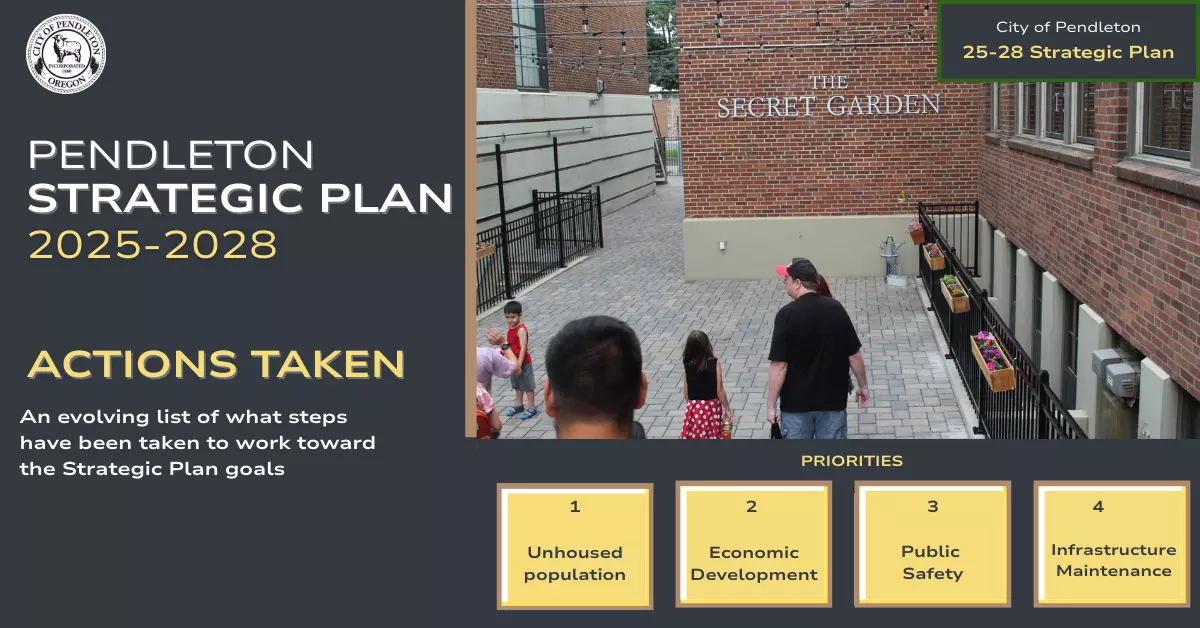
On Nov. 18, 2025, the Pendleton City Council adopted the Strategic Plan for 2025 to 2028.
The Strategic Plan outlines four main goals and different strategies identified to work toward meeting each goal. The purpose of this page is to track progress and show steps being taken to meet the Pendleton City Council Strategic Plan priority goals. This page was last updated on Jan. 19, 2025.
Strategic Plan Priority #1 relates to Homelessness/Unhoused individuals. The City of Pendleton has set up an FAQ section about homelessness. This is a work-in-progress, and more questions will be added as relevant.
Read more about the Strategic Plan.
Steps Taken
Pendleton Strategic Plan Update 08.28.26
Pendleton Strategic Plan Update August 17, 2026
Pendleton Strategic Plan Update 03.16.26
Strategic Plan Update Feb. 23, 2026
Strategic Plan Update Feb. 10, 2026
Strategic Plan Update Feb. 2, 2026
Strategic Plan Update Jan. 26. 2026
Strategic Plan Update: Jan. 19, 2026
Strategic Plan Update: Jan. 12, 2026
Strategic Plan Update: Dec. 22, 2025
Strategic Plan Update: Dec. 15, 2025
Strategic Plan Update: Dec. 8, 2025
Dec.1, 2025
From the City Manger
On Nov. 18, 2025, the Pendleton City Council adopted a Strategic Plan for 2025-2028. This plan was based on community input and seeks to improve the City of Pendleton through strategic goal-setting and actions items designed to achieve these goals. Priority areas from the survey are: Houseless/unhoused population, Economic vitality, Public safety, and infrastructure.
Activities of staff on strategies for the week of November 17, 2025:
The highest priority of the strategic plan is to reduce the unsheltered population and to reduce the crimes associated with the City’s resting ordinance. To accomplish this, one item the City is created at what we call a Policy Task Force to meet with community service providers in the areas of mental health, addiction, and housing, to identify ways the City might be a better partner to improve success. During this period the Task Force:
Attended the Key Partners Meeting hosted by U-COPE (Umatilla County Community Outreach, Prevention and Education)
Attended several meetings led by County Commissioner Cindy Timmons that included local service partners with a shared goal of creating a day shelter in partnership with Neighbor to Neighbor
Another action item of the City Strategic Plan is to meet with the law enforcement community to discuss the problems with the jail and court systems that are overrun. To accomplish this action item the City has created a different task force we call the Accountability Task Force. This group has had several meetings with Umatilla County Jail personnel. During this period members of the Task Force toured the Umatilla County Jail at the invitation of the Sheriff’s Office.
Other activities during this time related to the highest priority action items are as follows:
Staff met and discussed work being done to develop a communications plan to keep the public better informed about the City’s progress on the strategic plan,
The Police Chief met with an advisory committee to the Urban Renewal District to advise them on ways to address public safety needs in the downtown, and
Staff reviewed 40% of plans for a McKay Creek project in Community Park to reduce the risk of flooding and to enhance fish habitat.
- Robb Corbett, City Manager
Pendleton Built for Zero: A local commitment to reduce homelessness through collaboration and data
Built for Zero is not a program the City of Pendleton is purchasing. It is a community-improvement approach that helps local partners work together, use timely data, and pursue a shared goal: making homelessness rare, brief, and nonrecurring.
Community Solutions, the nonprofit that leads the national Built for Zero network, supports communities with coaching, peer learning, data expertise, and proven tools. In the past the initiative provided funding and flexible support to participating communities. It is not currently accepting or funding new cities. Instead they have created a DIY guide for cities to implement Built for Zero on their own using the open source tools provided by Community Solutions. It is not structured as cities paying Community Solutions for software, staffing, or a contracted service.
Our commitment is local. Pendleton’s commitment is to ourselves and our community, not an outside organization. We will assemble a system’s improvement group of organizations that regularly interact with people experiencing homelessness. Those organizations will agree to coordinate their efforts around a shared aim: reducing homelessness in Pendleton.
Built for Zero’s model centers on a single, accountable community team; a shared aim; person-specific, real-time data; and targeted, data-driven action.
Why data matters
Our initial focus is data collection and data quality. Before we can effectively reduce homelessness, we need a more complete and current understanding of:
- Who is experiencing homelessness in Pendleton.
- How people both enter and exit homelessness in Pendleton each month.
- What barriers are keeping people from housing.
Partners will work toward a shared, consent-based by-name list: a regularly updated, person-specific list that helps the community account for each person experiencing homelessness, avoid duplicate counting, coordinate appropriate support, and understand system-wide trends.
Once the system is established, designated staff will pull recurring monthly reports, update the public dashboard with aggregated information, and use the data to guide decisions about homelessness prevention, service coordination, and housing placement.
Transparency and local ownership
The City of Pendleton should lead the creation of a public-facing dashboard that reports community-level progress transparently.
The dashboard would share aggregated information such as:
- Number of people experiencing homelessness over time.
- Inflow: people newly entering homelessness.
- Outflow: people leaving homelessness, including exits to housing when known.
- Trends that can inform prevention strategies, service coordination, and housing investments.
A local dashboard would allow Pendleton residents, partners, and decision-makers to see both the challenge and our collective progress.
What Pendleton can do now
Pendleton does not need to begin with a large, fully developed operation. As a smaller community, we can start with a practical systems-improvement group that:
- Brings key organizations to one table.
- Establishes a shared local aim.
- Builds a reliable by-name list and improves data-sharing processes.
- Identifies gaps, bottlenecks, and prevention opportunities.
- Tests targeted improvements and measures their results.
- Reports progress publicly through a City-led dashboard.
With the FREE support from peer communities, Community Solutions’ policy and data staff, Built for Zero managers, and access to Built for Zero resources and tools, Pendleton can build a local system that learns continuously and makes better decisions with data. The goal is straightforward: work together so fewer neighbors experience homelessness, and those who do can return to housing more quickly.